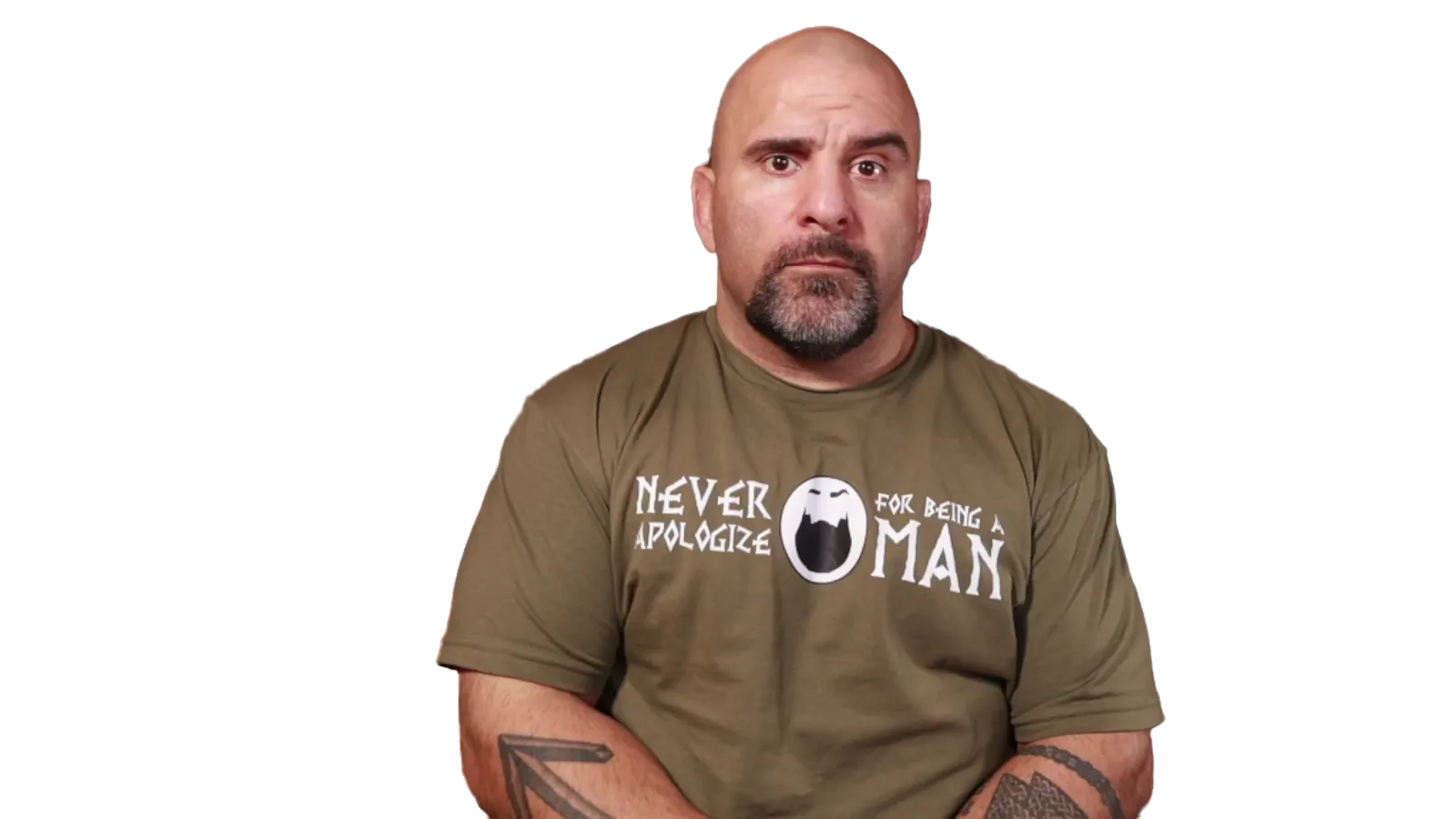
The Pressure You're Under
Is Showing You Exactly
Where You're Weak.
Read it right and it's a map to the man you're supposed to be, and I'll show you how.
Start with the daily letter. One move per morning. Free.
Daily email. Thousands of readers. Free Master the 24-Hour Cycle course on signup. Unsubscribe anytime.

“Extracts the most out of people. Legendary.”
Sebastian Junger · #1 NYT Bestseller, Tribe

“I have quadrupled my income.”
Darrell Thompson · Owner, Cultivate Power Fighting Arts

“My personal Joseph Campbell.”
Dr. Dan Luna · Retired 20-Year Navy SEAL
Why the letter exists
"If you are on the fence about his coaching program,
go all in and
don't fear the pressure.
It will transform you."
 Nick Castiglia
CEO, Legacy Martial Arts Consulting
You're Winning on Paper. Losing Where It Counts.
Does any of this sound like you?
-
01
You work harder than every man in your life, but your results just don't match your effort.
-
02
There's one conversation you've been avoiding for a year. You know exactly who it's with and exactly what you need to say.
-
03
You're looked up to by grown men on a daily basis, but you'll lose it on your kid for forgetting to put his shoes away.
-
04
You've read every book that you think matters, but nothing that matters changed because of it.
-
05
No man you respect has told you a hard truth in years. You can name a dozen times you needed one.
This has been going on for years. You hold it together at work and blow up at home. You work 70-hour weeks and still feel behind. The man your employees see at 9am isn't the man your family sees at 9pm.
That gap isn't going to fix itself. It's going to get worse. And the longer you let it run, the more it costs the people you built all of this for.
The men in this system were you. Same grind. Same gap. Same shelf full of books that didn't change a thing. They got three things at once that nobody hands you together:
- A system built for men who already outwork everyone else.
- A room full of men who won't let you hide.
- A coach who won't tell you what you want to hear.
You've got a path. Pick your way in.
They Were You. Now They're Not.
"Justin is the man on alliances."
"When it comes to understanding, developing, and leveraging alliances, Justin Garcia is the man."

Brian Bird
Founder / CEO
"Tools, systems, and guidance to scale my health services."
"Justin provided me with the tools, systems, and guidance to reignite and scale my health services."

Dr. Chris Lowthert
Chiropractor, Rockfish Chiro
"I endorse MC over all others I've experienced."
"I endorse MC and his personal coaching 100% over all others I have experienced."

Paul Sova
Veterinarian
"He pushes me as an entrepreneur to this day."
"He continues to push me as an entrepreneur to this day."

Anthony Sepulveda
Content Creator, Coach
"Meets you exactly where you are."
"His coaching style meets you exactly where you are."

Jay Skeeters
CEO, Thrive: Mind/Body
"His business systems set us on a whole other level."
"Following Master Chim's business systems has set us on a whole other level."

Patrick Kelly
School Owner
"He helped me level up every aspect of my life."
"How do you express gratitude to a man that has helped guide you to level up every aspect of your life?"

Joshua Martinez
Owner, True North Training / Firefighter
"Best decisions of my life. Made with his guidance."
"Many of the best decisions I've made in my life were made in part with his guidance."

Brian Roff
Coach, Owner of The Macroset
"Teaching me to be a better leader and business owner."
"He's teaching me how to be a better leader and business owner."

Oscar Covarrubias
Owner, Real Estate Investor
"The pressure you don't want, but the one you need."
"Master Chim is an expert at applying the pressure you might not want, but you need."

Jessie Suarez
Dog Behaviorist / Trainer
"He's pulled me up every time I've fallen."
"I can't count the number of times his programs and coaching have pulled me up after I've fallen."

Lorenzo
Owner
"The 9 Flow System has helped me tremendously."
"MC has helped me tremendously through several approaches. The latest being the 9 Flow System."

Mike Dunson
Plumbing Contractor
You Know the Man You Should Already Be. Pressure Keeps Showing You the One You Actually Are.
Every morning for 30 days you get one short audio from me. It hits the gap between those two men and gives you one thing to do about it that day. That's the whole thing. Audios in your ear, a one-line reminder in your inbox, and 30 days of you closing that gap instead of staring at it.
$47 now. From there it goes to $67, then $97. The price only goes up.
Three Ways In. Same System.
Pick Your Format.
Every program runs on the Pressure to Power Metamodel. The difference is how the coaching is delivered.
A Tribe of Men Who Won't Let You Fake It Anymore
The long game. A tribe of men operating at a standard you won't find in any other room. Weekly calls. Daily accountability. The men in this room have been here for years because nothing else compares.
Join on Skool10 Private Sessions That Force a Permanent Shift
Direct access. Personalized frameworks. Strategic pressure applied to your specific situation by someone who has spent 25 years doing exactly this. You bring the problem. We build the system. By application only.
Apply NowA Room of Business Owners Who'll Tell You What Nobody Else Will
A mastermind for men building businesses. The room where entrepreneurs operate at a level of honesty, accountability, and strategic pressure that doesn't exist in any other group. Vetted. Selective. Results-driven.
Apply NowTen Programs. Seventy Lessons.
The Work That Sits Under Everything I Teach.
For years these ten programs were only inside my coaching groups. I brought all ten back and put them in one download. Seventy video lessons plus the audio versions, on your machine tonight, yours to keep. There are no calls, no room to join, and no schedule to keep. You work it when you work it.
$47 for the first 100 men, then the price goes to $97.
Three Steps. The First One Takes Five Minutes.
Apply
Fill out a short application. It tells me who you are, what you're working with, and what's not working. Five minutes. No payment. No commitment.
Assess
If the application looks like a fit, we get on a call. I assess where you are, what's leaking, and which program matches your situation. No pitch. If it's not a fit, I'll say so.
Build
You enter the system. You get the frameworks, the pressure, and the tribe. You start building. We hold you to it.
You'll hear back within 24 hours.
What Happens When Men Stop Tolerating Their Own Excuses
"His ability to extract the most out of people is legendary."
"The razor's edge that separates weakness from personal power is something that becomes more tangible and attainable with the right mindset."

"Warrior, teacher, scholar. One of the few I made a point to stay in contact with. My personal Joseph Campbell."
"I have quadrupled my income."
One System. Three Roads. Everything Else Is Built on It.
The Pressure to Power Metamodel is the unified system behind every program, every framework, and every coaching session. It maps how pressure converts into identity, Will, structure, and Real Power. It took 25 years to build. Nothing else like it exists.
What the Pressure to Power Metamodel is, explained in full.
The Self Road
Internal discipline. Emotional regulation. Personal coherence under pressure. If you can't govern yourself, you will be governed by circumstance. This is where every man starts.
The Tribe Road
Relationships. Alliances. Leadership. Your power must survive contact with other people. Presence is either stabilizing or corrosive. There is no neutral man in a group.
The Value Road
Production in the world. Business. Execution. Outcomes. The world does not reward intention. It rewards results. Value exposes delusion because consequence can't be negotiated.
Force Flow = Will × Structure ÷ Friction. That's the equation. 12 proprietary frameworks live inside this system. Each one targets a specific failure point on a specific Road.
Force Flow = Will × Structure ÷ Friction
Will is the engine of the entire cycle. Without Will, nothing moves.
Structure is the architecture that carries will from intention into action.
Friction is the resistance the world applies to a man's attempt to move power into reality.
Force Flow is the fraction of Will that survives structure and friction.
That's the equation. 12 proprietary frameworks live inside this system. Each one targets a specific failure point on a specific Road.
The Questions You're Already Asking
Is this only for martial artists?
No. The men in this system run businesses, lead teams, raise families. The martial arts background is where the frameworks were built, not who they're built for. The system works because pressure is universal. Every man faces it. Most men have no system for converting it.
How is this different from therapy or other coaching?
Therapy helps you understand why you feel what you feel. This system gives you a framework for what to DO about it.
Most coaching gives you motivation and accountability. This gives you a structural operating system that runs whether you feel motivated or not. The men who come here have usually tried both. They come here because understanding the problem and solving it are two different things.
How much time does this take per week?
The Pressure Process is one session per week, under an hour. Three Roads Mastermind is two live calls per week plus a community you engage with on your schedule. Inner Circle includes two mastermind sessions per week, monthly 1-on-1 time, plus multiple events and workshops throughout the year.
You already waste more time than any of this requires on things that aren't moving you forward.
What if I've done coaching before and it didn't work?
Good. That means you've already learned what doesn't work for you.
Most coaching fails because it's built on motivation, not structure. Motivation fades. Structure doesn't. If you've tried before and it didn't stick, the system was the problem, not you.
What does the first step look like?
You fill out an application. It takes five minutes. If it looks like a fit, we schedule a call. The call is a direct assessment of where you are and what's leaking. No pitch. No pressure besides your own. If it's not a fit, I'll tell you.
Is there a guarantee?
No. A guarantee would attract men looking for a safety net. This system is for men looking for a result.
You show up, you do the work, you apply the frameworks. The men who do that get results. Every time. The men who want a refund policy before they've started aren't ready for this.
You Read This Far. That Tells Me Something.
Most men bounce after the first two sentences. You're still here. That means you recognized something on this page that hit.
The next step is a conversation. No sales pitch. No contract. Just a direct assessment of where you are and whether this system is the right fit.
- No contracts. No long-term commitment required.
- Free initial assessment. No obligation to proceed.
- Application-only. This filters out men who aren't serious.
You'll hear back within 24 hours.
"I wouldn't have been able to do any of that if Justin hadn't been a part of my life."
Fred Warder
Entrepreneur, Home Services & Real Estate
7 years working with MC
Daily Pressure Delivered to Your Inbox
Thousands of men start their morning with this email. One framework, one story, one piece of direct talk that says the thing nobody else in your life will say. Every day. Under 3 minutes to read.
Free on signup: Master the 24 Hour Cycle, a 5-module course on the daily performance template I use and teach to every private client. It's the same system behind the TRIM Framework. Yours free.
Thousands of readers. Unsubscribe with one click. No spam, ever.