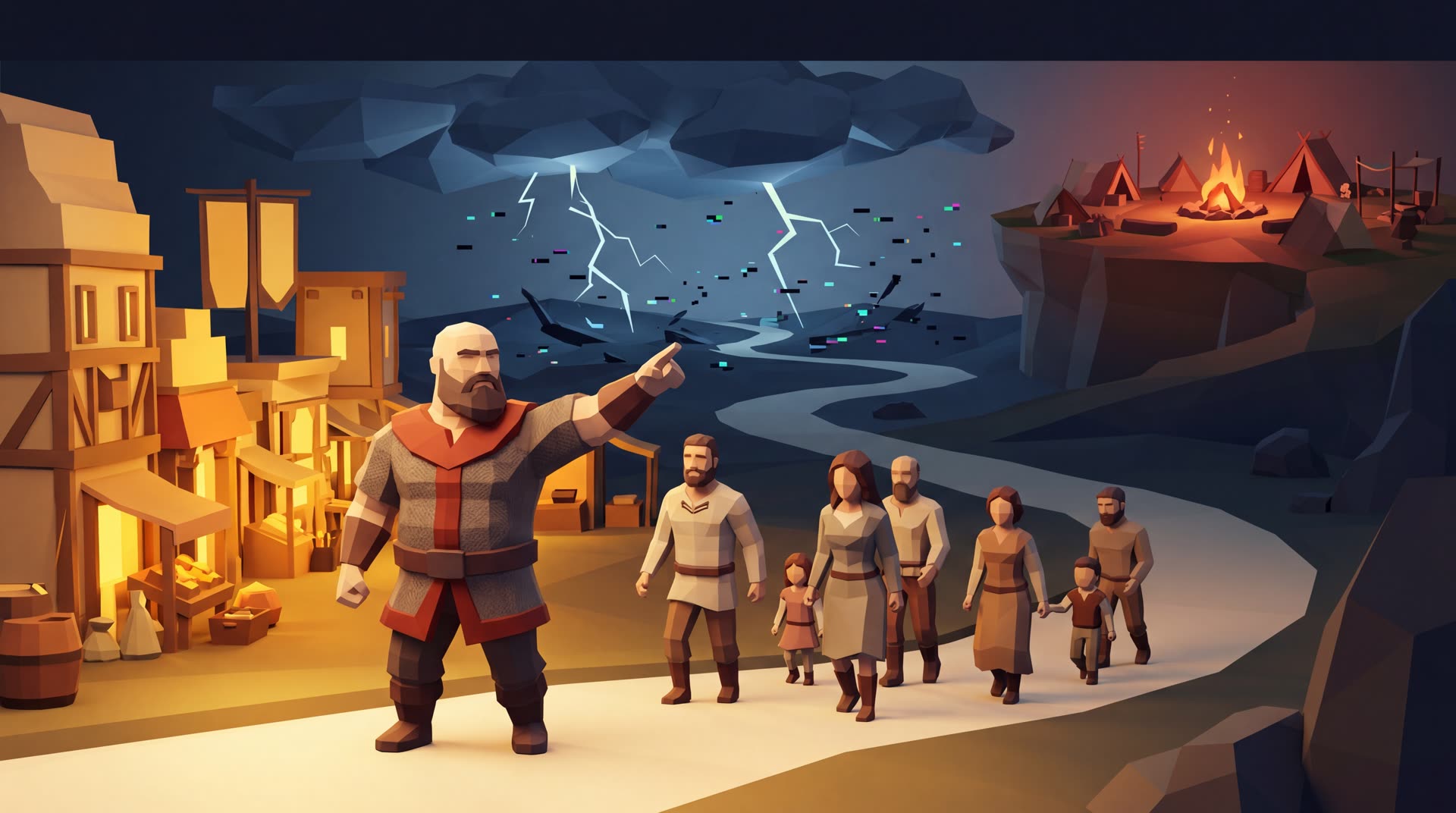
Parts 1 through 4 walked you through what happens inside a man. The arc. PASS, SCIN, GAP, BLUR, FOLD. That’s your interior. This part pivots. When enough men in a population walk that arc at the same time, the population itself goes through three stages. Predictable. Sequenced. Every man who leads a tribe is going to lead it through all three. The stages don’t care whether you have language for them. They still land. The difference is whether you’re reading them or being read by them.
Every man reading this is already leading a tribe. His family is a tribe. His team is a tribe. The men he runs with are a tribe. His kids are the next generation of a tribe he’s building whether he knows it or not. Tribe is the word I’m using for the people whose decisions are influenced by yours, who watch your posture to decide what matters, and who look to you when they don’t know what to do next.
Those people are about to walk through three stages. You can walk them through it awake or asleep. Awake is cheaper.
Why the Stages Follow Automatically
The Great PASS is the population-level version of the event. Enough individuals get PASS’ed in a medium that the collective default assumption (“a human made this”) stops producing reliable results. Text is already there. Voice is close. Image varies. Video is accelerating. Different media cross the line at different times, but they all cross it eventually.
Once a medium crosses, the society that depends on that medium has to adjust. It adjusts in three stages, in order, because human nature does the same thing every time it encounters a compromised trust channel. First it over-trusts. Then it overcorrects. Then it retreats to what it can verify directly.
The stages aren’t optional for the population. They’re optional for you in the sense that you can be present inside them instead of carried by them. That’s what this part is about.
Over-Trust shows up first because the AI output is actually useful. AI wrote the email that closed your last deal. AI made the image that got the click. AI handled the customer service case that would have taken your guy three days. AI drafted the proposal that landed the account. All of it works. None of it triggers a red flag because the outcome is legitimate. The deal closed. The customer was happy. The proposal landed.
This is why Over-Trust is the easiest stage to miss. Your team stops flagging the origin of what they’re consuming because origin stops mattering to the outcome. Productivity goes up. People feel smart. Everyone’s moving faster. The culture around you shifts from “where did this come from?” to “did it work?” over about eighteen months without anyone announcing the change.
- Your team forwards AI-written summaries as if they wrote them themselves.
- Customer reviews you used to trust as signal now feel slightly off but you can’t say why.
- Your peers are quoting AI output as their own analysis in meetings.
- Your inbox is running smoother than it used to and you haven’t added headcount.
- You got a voicemail last week and it took you a beat to be sure it was a real person.
Utility replaces origin. Once the output is useful, nobody’s asking who made it. When nobody’s asking, synthetic signal becomes the default input into every decision your tribe makes. The shift doesn’t get voted on. It happens because checking feels like a friction nobody wants during a win.
Run origin-checking out loud, even when nobody else is. When your son shows you a paper, you ask him how he wrote it. When your team sends you research, you ask who pulled it together. When someone sends you an “amazing review,” you ask who wrote it and whether they’ve been verified. You’re not being suspicious. You’re installing a muscle your people are about to need. Your kids watch it. Your team watches it. The culture of any tribe gets set by what its leader treats as important. If you treat origin as important, they will too.
Your tribe’s decisions are running on a mixed feed of real and synthetic signal that none of you can break apart anymore. The hires you made this year. The investments you approved. The partnerships you signed. Some fraction ran on synthetic input. You don’t know which fraction. You’ll find out in Stage 2, when the bill arrives.
Rebound happens when the damage from Over-Trust lands visibly. Men start discovering they hired off fake resumes. Businesses realize the Q3 intel that shaped their plan was AI-generated noise. Dating markets report widespread catfishing with AI photos and voice clones. Political campaigns get caught running synthetic personas. Scams scale. Losses stack. The “adequate convenience” of Stage 1 reveals its price tag, publicly.
The culture responds the way it always responds to being fooled collectively. Hard swing the other way. Broad distrust. Everyone becomes a conspiracy theorist overnight. “Nothing’s real.” “They’re all lying.” “Don’t trust any of it.”
This sounds healthy, like at least people are thinking critically again. It isn’t. What actually happens is your tribe goes paralyzed. They can’t tell the difference between a real review and a fake one, so they reject all reviews. They can’t tell a real candidate from one with an AI-enhanced resume, so they stop hiring. They got burned on a deal that turned out to be synthetic, so they stop making deals. Undifferentiated distrust costs as much as Over-Trust did. Different side of the ledger, same tax.
- People in your life keep saying “everything’s fake now.”
- Your team’s gotten slower because they’re verifying things that don’t need verifying.
- Legitimate opportunities are getting passed on because they “feel AI.”
- Everyone around you is more cynical than they were a year ago and nobody is more effective.
- Your kids don’t believe anything they read online, including the true things.
Mistaking cynicism for detection. Cynicism doesn’t require calibration. It just requires rejecting everything. It feels like sharpness but it produces worse decisions than Over-Trust did, because at least Over-Trust said yes to real signals. Rebound says no to everything.
Hold calibrated trust when the culture around you is collapsing into blanket cynicism. When the real candidate walks in, you still see him. When the real deal shows up, you still take it. When the real friend reaches out, you still respond. You can’t lead a frozen tribe unless you’ve kept the ability to tell real from fake yourself. That’s the GAP work from Part 2 earning its keep, at a stage where everyone around you has stopped doing it.
You also teach your tribe the difference between sharp and cynical. This is a posture conversation, not a lecture. They watch you say yes to real things when everyone else is saying no. They watch you say no to bad things without becoming bitter. They learn from that.
Your tribe stalls. They miss the real hires, the real deals, the real relationships. You become the paranoid uncle instead of the leader. Decisions shrink to defensive only. The world moves around you while you’re busy suspecting everything.
Tribal Contraction shows up when the broad coordination tools stop producing coordination. The institutions and platforms humans built for large-scale cooperation, mass media, social platforms, broadcast advertising, institutional credibility signals, even email as a trust channel, were all designed assuming the signals they carried came from humans. When that assumption breaks at scale, the infrastructure keeps running but stops producing the outcome it was built for. It generates content, noise, traffic, impressions. It stops generating coordinated trust.
The crowd adapts. People stop looking to institutions for verification and start looking to their immediate, physically-known circles. Their church. Their gym. Their private group chat of six guys. Their neighborhood. Their kids’ school community. These weren’t new. They were always there. But they stop being secondary to the big structures and become primary.
This sounds nostalgic and local and romantic when you describe it on paper. In practice it’s brutal for a man without a pre-built tribe. He hits Stage 3 looking for a room to belong to because the old signals have stopped working, and everyone around him is already inside their room. He’s late. He’s trying to build what other men built over years. He’s scrambling when he should have been the guy others were finding their way toward.
- People you know are leaving major platforms in favor of small private groups.
- Referrals are beating ads across every business you know.
- Local, in-person events are getting more energy than online ones.
- Nobody trusts “the news” anymore, but everyone trusts their neighbor who heard it from a guy.
- Your kids’ friendships are forming more around school and sport than social platforms.
- Family group chats carry more weight than anything outside them.
Arriving at Stage 3 without a tribe already built. Tribal Contraction rewards men who authored rooms earlier. It punishes men who assumed the big structures would keep working forever.
Your tribe has to exist before the contraction forces it. That means you’re building now, before it’s obvious. You’re the guy hosting the dinners. You’re the guy starting the group chat and curating who’s in it. You’re the guy putting the Sunday run together and showing up every week until it’s a thing. You’re the guy your team actually knows personally, not just as a boss. You’re the father who has real one-on-one time with each of his kids and knows the men they’re friends with.
None of this is new. Every generation of effective men has built tribe around them. What’s changing is the stakes. Men who built tribe over the last decade were rewarded with a good life. Men who build tribe in the decade ahead will be rewarded with a tribe that still functions when the big structures stop. That difference gets more substantial every year.
When Stage 3 lands, you’re looking for belonging instead of providing it. Your family has to find their sense of place elsewhere because you didn’t build one for them. Your team looks to someone else for leadership because you weren’t leading. Your kids inherit a posture of seeking instead of authoring. That’s the generational cost, and it’s the one that’s hardest to recover from.
One Requirement, Three Different Tests
Every stage is asking the same thing of you in a different form. Lead the tribe that depends on you through what’s in front of you. The stage changes, the leadership task stays the same.
In Over-Trust, you model detection when nobody’s asking for it. You slow the culture around you down enough to keep origin as a question that matters. You install a muscle in your tribe before they’ll need it.
In Rebound, you hold calibrated trust when everyone around you is collapsing into cynicism. You keep your tribe saying yes to real signal when the broader culture is saying no to everything.
In Tribal Contraction, you have the tribe already built. You’re the center of gravity for your people instead of a man looking for belonging yourself. You’re the one others are finding their way toward.
Each stage demands a different posture. Each stage arrives on its own timeline. The medium you operate in determines when each one shows up for you. Text is already rolling through Over-Trust and starting to Rebound. Voice is still deep in Over-Trust. Video is pre-Over-Trust. Image depends on the category. Your leadership position depends on reading the stage you’re in across each medium your tribe uses.
The framework does one job. It lets you lead through the stages with your eyes open instead of reactive. The stages come for every man either way. The only variable is whether your tribe walks through them behind a leader who saw it coming, or scrambles with a leader who didn’t.What This Means For The Man Reading This
You’re already leading a tribe. Your family is a tribe. Your team is a tribe. Your peers are a tribe. Your kids are the tribe that inherits whatever posture you modeled.
Your job in the decade ahead is the same as it’s been in every decade: read the stage, lead the people who look to you, build the room they’ll need before they need it. The framework gives you a map so you can do that consciously instead of reacting to things after they’ve already cost you something.
Five terms for the individual arc. Three stages for the civilizational arc. Eight words total. Eight words is a small amount of language. A small amount of language, used correctly, can change a generation of men who depend on you.
A man who has these words can see what’s coming for himself. He can see what’s coming for his family, his team, his community. He can position before the stage closes around him. He can teach it to the men around him in under twenty minutes. He can lead his sons into an environment he’s already mapped.
A man without the framework walks the same stages, but he walks them blind. The stages don’t care whether he can name them. They still happen. His tribe still walks through them. The only variable is whether he’s reading them for his people or being read by them.
You have the words now. The work starts the day you decide your tribe is worth leading through this consciously.
~MC
PS: Five articles. Eight words across them. That’s the whole framework. What you do with it is between you and the people who look to you to know what’s coming.